Digestive symptoms were common in the STEP trials of once-weekly injected semaglutide, but a single percentage cannot describe the whole experience. Some participants reported brief vomiting or diarrhea episodes; constipation often lasted much longer. Most recorded events were mild or moderate, yet severe symptoms and treatment discontinuations occurred. Understanding those distinctions is more useful than describing the medicine as either easy or difficult to tolerate.
The central evidence is an exploratory analysis of existing STEP trial data, not a new trial designed to make people nauseated or test symptom remedies. Its full primary report helps answer three practical scientific questions: how symptoms were collected, how their timing and duration varied, and whether weight reduction depended on experiencing them. Current official prescribing information supplies a separate framework for recognizing symptoms that need clinical assessment.
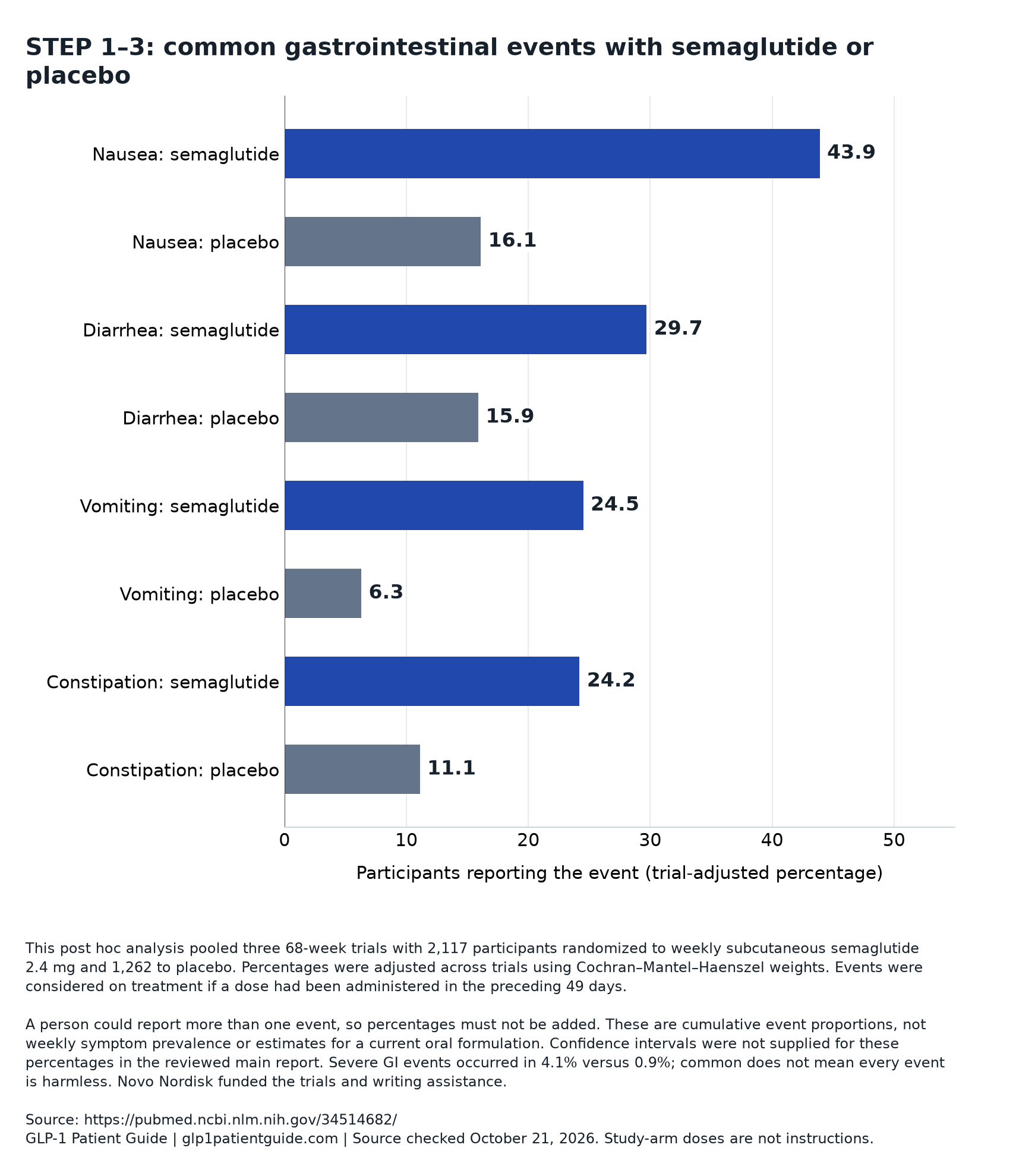
STEP 1–3: common gastrointestinal events with semaglutide or placebo
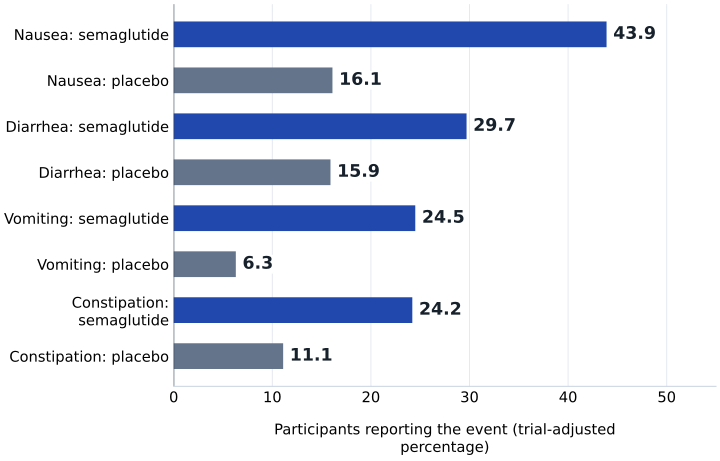
This post hoc analysis pooled three 68-week trials with 2,117 participants randomized to weekly subcutaneous semaglutide 2.4 mg and 1,262 to placebo. Percentages were adjusted across trials using Cochran–Mantel–Haenszel weights. Events were considered on treatment if a dose had been administered in the preceding 49 days.
A person could report more than one event, so percentages must not be added. These are cumulative event proportions, not weekly symptom prevalence or estimates for a current oral formulation. Confidence intervals were not supplied for these percentages in the reviewed main report. Severe GI events occurred in 4.1% versus 0.9%; common does not mean every event is harmless. Novo Nordisk funded the trials and writing assistance.
Source 1Download the source-labeled chart (PNG) · Download the data (CSV)
| Event and randomized assignment | Reported value |
|---|---|
| Nausea: semaglutide | 43.9 |
| Nausea: placebo | 16.1 |
| Diarrhea: semaglutide | 29.7 |
| Diarrhea: placebo | 15.9 |
| Vomiting: semaglutide | 24.5 |
| Vomiting: placebo | 6.3 |
| Constipation: semaglutide | 24.2 |
| Constipation: placebo | 11.1 |
Sections in this article
What the pooled analysis actually studied
STEP 1–3 were randomized, placebo-controlled trials lasting 68 weeks. This later analysis combined their safety data for the semaglutide 2.4 mg and placebo arms. Semaglutide was given by subcutaneous injection, meaning under the skin. The dose identifies the studied intervention; the historical trial schedule is not an individual treatment plan.
The populations were not identical. STEP 1 and STEP 3 enrolled adults without diabetes who had obesity, or overweight with a weight-related condition. STEP 2 enrolled adults with overweight or obesity and type 2 diabetes. Lifestyle support also differed: STEP 3 used intensive behavioral therapy, whereas the other two used lifestyle intervention.
Adverse-event incidence was a supportive secondary safety endpoint in the original trials. The pooling and analyses connecting symptoms with weight loss were post hoc, meaning developed after the original trial plans. They provide detailed exploratory evidence, but not a new independently randomized test of digestive symptoms. The distinction between evaluation and prescribing is also relevant to the guide on the steps from intake to prescription.
Source 1How participant reports became safety data
Researchers collected adverse events using open-ended, non-leading verbal questions. They recorded onset and end dates and followed reported events at later visits or contacts. Events were coded using a standardized medical terminology system and classified by severity and seriousness. This was structured follow-up of participant reports, not continuous monitoring of digestive function.
For safety analyses, someone counted as on treatment if any trial dose had been administered within the preceding 49 days. That definition matters: these were not simply symptoms occurring on injection day. It also differed from the two-week exposure window used for the descriptive week-68 weight analysis.
The published pooled percentages were weighted to account for differences between trials. Consequently, dividing raw participant counts in the disposition table does not reproduce every reported incidence. Weighting preserves the contribution of the individual studies rather than treating their combined enrollment as one undifferentiated trial. For everyday care, the reporting process highlights a useful question raised in the video-visit and messaging guide: how will symptoms be documented and reassessed?
Source 1Reading the symptom percentages without adding them
At least one gastrointestinal event was reported by a weighted 72.9% of semaglutide participants and 47.1% of placebo participants. The placebo frequency is important: digestive symptoms also occur without active medication. The between-group contrast is more informative about treatment-associated excess than the semaglutide percentage alone.
Nausea showed the largest absolute difference among the four common symptoms: 27.8 percentage points. For vomiting, the difference was 18.2 points. These are percentage-point differences in the proportions reporting symptoms, not changes in symptom intensity or numbers of episodes.
The rows overlap. A participant reporting nausea and vomiting contributes to both categories, so adding the four percentages would double-count some people. Nor does a 43.9% nausea incidence mean that 43.9% were nauseated throughout follow-up. Incidence records whether a participant experienced an event during the observation period.
| Reported event | Semaglutide 2.4 mg | Placebo |
|---|---|---|
| Any gastrointestinal event | 72.9% | 47.1% |
| Nausea | 43.9% | 16.1% |
| Diarrhea | 29.7% | 15.9% |
| Vomiting | 24.5% | 6.3% |
| Constipation | 24.2% | 11.1% |
Why event severity is not a count of unharmed people
Two reassuring-looking results require careful denominators. Among gastrointestinal events recorded with semaglutide, 99.5% were classified as nonserious and 98.1% as mild or moderate. These describe events, not percentages of participants who escaped harm or discomfort.
Severity and seriousness are different classifications. Severity describes intensity; seriousness uses standard safety criteria rather than intensity alone. A nonserious event can still disrupt daily activities, prompt a clinical discussion, or lead to a treatment change. The two labels should not be used interchangeably.
At the participant level, severe gastrointestinal events were reported by 4.1% receiving semaglutide and 0.9% receiving placebo, an absolute difference of 3.2 percentage points. Reported severe events included nausea, abdominal pain, diarrhea, and vomiting. Thus, the predominance of mild or moderate events coexisted with a smaller but clinically important group experiencing severe symptoms.
Source 1Timing and duration answer different questions
Events occurred most often during or shortly after dose escalation. In these historical trials, escalation extended through week 16. The cumulative proportion experiencing a first gastrointestinal event largely leveled off after about week 20. That pattern indicates fewer new people having their first event later, not an absence of later or recurrent symptoms.
Weekly prevalence—the proportion experiencing a symptom at a particular time—also changed. Nausea, diarrhea, and vomiting peaked around week 20 and declined thereafter, although they remained more prevalent with semaglutide than placebo over the treatment period. A falling prevalence can reflect resolution of earlier events while some participants continue having symptoms.
Researchers estimated median individual event durations using a method that accommodates incomplete follow-up. Constipation stood apart from the shorter nausea, diarrhea, and vomiting episodes. These medians are not maximum durations or a participant’s total symptom burden, and they are never instructions to wait before seeking help.
| Measure | Reported finding | Interpretation |
|---|---|---|
| Nausea event duration | Median 8 days with semaglutide | An episode estimate, not total days of nausea per participant |
| Diarrhea event duration | Median 3 days with semaglutide | Does not exclude longer or repeated episodes |
| Vomiting event duration | Median 2 days with semaglutide | Short duration does not make severe vomiting harmless |
| Constipation event duration | Median 47 days with semaglutide; 35 with placebo | Longer-lasting than the other common symptoms; not a waiting recommendation |
| First-event timing | Cumulative incidence largely plateaued after week 20 | Later first events became less frequent, but symptoms did not disappear |
Stopping medication differed from leaving the research
Gastrointestinal events led to dose reduction or temporary treatment interruption in 12.5% of semaglutide participants versus 1.7% receiving placebo. Permanent medication discontinuation specifically because of gastrointestinal events occurred in 4.3% versus 0.7%, mostly during escalation. These measures describe different consequences and should not be combined into one dropout rate.
All-cause permanent treatment discontinuation was broader: 16.0% with semaglutide and 19.1% with placebo. Those figures include reasons beyond digestive symptoms. The lower overall discontinuation percentage with semaglutide does not negate its higher gastrointestinal-specific discontinuation percentage; the categories answer different questions.
Participants could stop medication while remaining in research follow-up. At week 68, 94.8% of the semaglutide group remained in the trial, but 84.0% were on treatment. Editorial interpretation: continued contact should not be confused with continued medication use when assessing care arrangements. The guide to a plan that does not fit addresses that practical distinction; a Ro review can be used to check documented service and cancellation terms, not to infer trial-level care or outcomes.
Source 1Weight loss occurred with and without reported symptoms
Among semaglutide participants still on treatment with a week-68 weight measurement, mean weight reductions were substantial in both symptom groups. In STEP 1, reductions were 17.3% with any gastrointestinal event and 15.7% without one. Corresponding figures were 11.4% and 9.6% in STEP 2, and 17.7% and 17.1% in STEP 3.
These comparisons support a bounded interpretation: reporting digestive symptoms was not necessary for substantial observed weight loss. They do not establish identical outcomes between groups. Participants were randomized to medication or placebo, not to nausea or no nausea, and differences between those later symptom groups could reflect other characteristics or treatment experiences.
Selection is especially important here. The descriptive analysis excluded people who had stopped treatment before week 68 or lacked that weight assessment. It therefore describes retained, measured participants better than everyone who began treatment. The findings argue against treating nausea as proof that treatment is working, but do not predict an individual’s eventual weight change.
Source 1What the less-than-one-percentage-point model means
The investigators also used mediation analysis, a statistical approach that separates a treatment effect into a portion linked through an intermediate event and a remaining portion. Here, gastrointestinal events were the proposed intermediate step between treatment and weight change. The model estimated that less than one percentage point of additional weight loss versus placebo was mediated by those events.
The unit is percentage points of body-weight change, not less than 1% of participants or necessarily less than 1% of the total treatment effect. For illustration, a one-percentage-point contribution would represent one unit on a body-weight-change scale expressed in percent. The reported estimate was below that threshold; it was not a finding that symptoms explained all or most weight reduction.
The model assumed no unmeasured confounding beyond included variables, although symptoms occurred after randomization. Symptom timing was also incompletely represented. These assumptions prevent the result from proving causal independence. The figure used 95% Wald confidence intervals, but numerical bounds are not available in the accessible main-text rendering used here; precise intervals should not be reconstructed from prose or mistaken for the standard-error bars in the descriptive weight figure.
Source 1STEP 4 and SURMOUNT provide distinct supporting evidence
STEP 4 must remain separate from the pooled analysis. Of 902 people entering a 20-week open-label semaglutide run-in, 803 who tolerated the target dose were randomized to continue semaglutide or switch to placebo. Ninety-nine did not reach randomization, with adverse events cited for 48. This selection makes maintenance findings unsuitable as estimates of starting-treatment tolerability.
During run-in, 71.4% reported gastrointestinal events, and 44 participants discontinued treatment because of them. After randomization, newly beginning gastrointestinal events occurred in 41.9% continuing semaglutide versus 26.1% switching to placebo. These results show that later events remained possible even among selected tolerators; they do not erase early intolerance.
A separate post hoc SURMOUNT analysis found substantial tirzepatide-associated weight reduction with and without nausea, vomiting, or diarrhea. Its mediation analyses in SURMOUNT 1–3 linked those symptoms, with or without indigestion, to up to 3.1% of the total weight-reduction effect—a different unit from STEP’s percentage-point statement. Our SURMOUNT scientific explanation examines those designs. Neither analysis directly compared the two drugs, so their adverse-event percentages cannot establish a tolerability ranking.
Source 1 Source 3When current safety information changes the interpretation
Current Wegovy prescribing information states that semaglutide delays gastric emptying and is not recommended for people with severe gastroparesis. Older discussion about long-acting medicines and limited emptying delays should not override that current warning. Persistent or severe abdominal pain, sometimes radiating to the back and with or without vomiting, warrants prompt assessment for pancreatitis or another cause.
Vomiting and diarrhea can cause dehydration, with kidney injury reported in that setting. Gallbladder disease is another recognized concern. Postmarketing reports include ileus, intestinal obstruction, and severe constipation with fecal impaction, but voluntary reports cannot reliably establish their frequency or causality. Severe, worsening, or persistent symptoms therefore deserve assessment rather than reassurance based on a median trial duration.
Before anesthesia or deep sedation, patients should tell the procedural team about treatment because delayed emptying and aspiration reports matter; the label does not establish a universal withholding schedule. Editorial interpretation: documented access and escalation arrangements deserve attention when reviewing services. A Noom Med review can help readers check documentary terms, but does not show that any provider offers the studied intervention or reproduces its outcomes.
Source 2 Source 1Questions about the evidence
Does no nausea mean semaglutide is not working?
No. Participants without reported gastrointestinal events still had substantial mean weight reductions in the observed week-68 analysis. Symptoms were not assigned experimentally, and the analysis selected people still taking treatment with an available measurement. It supports rejecting nausea as a required marker of benefit, not predicting any particular person’s response.
Source 1Should someone wait 47 days before reporting constipation?
No. Forty-seven days was an estimated median duration of individual constipation events, not a recommended waiting period. Persistent or worsening constipation should be discussed with a clinician, especially when accompanied by pain or vomiting. Severe symptoms require prompt assessment; the current label includes postmarketing reports of obstruction and fecal impaction.
Source 1 Source 2Did STEP prove that fiber, probiotics, or anti-nausea medicines prevent these problems?
No. This analysis did not randomly assign those approaches or compare their effectiveness. Trial follow-up and clinician-managed treatment changes formed part of the research setting, but their presence does not establish which supportive strategy worked. These results should not be repurposed as evidence for a supplement or a self-directed symptom-treatment protocol.
Source 1Do these percentages apply to oral semaglutide or compounded products?
Not automatically. The analysis studied once-weekly subcutaneous semaglutide with a 2.4 mg target dose under specific trial conditions. Although current Wegovy labeling includes tablets, these injection findings do not establish tablet tolerability. They also do not validate other formulations, compounded products, or the outcomes of any particular care service.
Source 1 Source 2Who funded the research, and what remains uncertain?
Novo Nordisk funded STEP 1–4 and writing assistance; three authors were company employees and shareholders, and other industry relationships were disclosed. The findings remain informative, but independent replication, better modeling of recurrent symptoms, and analyses including treatment discontinuers would strengthen interpretation. This explanation uses the full main report and Table 1; supplementary files and original protocols were not independently reviewed.
Source 1Editorial assessment
The strongest conclusion is descriptive: digestive events were more frequent with injected semaglutide than placebo, clustered around escalation, and varied considerably in duration and consequences. Weight-loss comparisons and mediation modeling suggest that reported gastrointestinal events explained little of the observed benefit, without proving a mechanism. For patients, symptom absence is not evidence of treatment failure, and symptom frequency is not permission to dismiss severe illness.
Research access and limitations
This assessment centers on an exploratory pooled analysis and a separate selected-tolerator withdrawal trial. It uses the full main semaglutide and tirzepatide reports, not independently reviewed supplements or original protocols, plus targeted current official label sections. Trial follow-up, post-randomization symptom grouping, retained-participant weight analyses, and unmeasured confounding limit generalization and causal interpretation.
Where the information comes from
Scientific sources checked October 21, 2026. Earlier research and provider sources retain their dated histories below. Provider pages describe their own offers; they do not independently prove the quality of care.
- Gastrointestinal tolerability of once-weekly semaglutide 2.4 mg in adults with overweight or obesity, and the relationship between gastrointestinal adverse events and weight loss.Full primary post hoc analysis main text and main Table 1 reviewed; supplementary file and original trial protocols not independently reviewed. · Checked 2026-10-21
- DailyMed: WEGOVY semaglutide current prescribing informationCurrent official DailyMed label, updated June 18, 2026, current archive June 30, 2026; indications, relevant safety sections 5.2, 5.3, 5.5, 5.6, 5.10, postmarketing experience and oral-drug interaction sections reviewed. Other sections not fully reviewed. · Checked 2026-10-21
- Gastrointestinal tolerability and weight reduction associated with tirzepatide in adults with obesity or overweight with and without type 2 diabetes in the SURMOUNT-1 to -4 trials.Full primary post hoc report, Methods, Results, main Table 1 and Discussion/funding reviewed; supplementary tables and source-trial protocols not separately reviewed. · Checked 2026-10-21