Does feeling sick explain the weight loss seen with tirzepatide? An analysis of the SURMOUNT-1 through SURMOUNT-4 trials addressed that question by comparing weight change among participants who did and did not report nausea, vomiting or diarrhea. Substantial average weight reduction occurred in both groups. The findings challenge the idea that digestive discomfort is necessary evidence of benefit, while leaving important questions about symptom burden and individual experience unresolved.
This was a post hoc analysis: researchers revisited data from completed randomized trials rather than conducting a new experiment assigning people to experience symptoms. Its strongest contribution is the consistent pattern across different trial populations. Its principal limitation is that symptoms developed after treatment began, and the weight analyses excluded measurements after treatment discontinuation. Understanding those details helps distinguish a useful finding from an overly simple claim that side effects never matter.
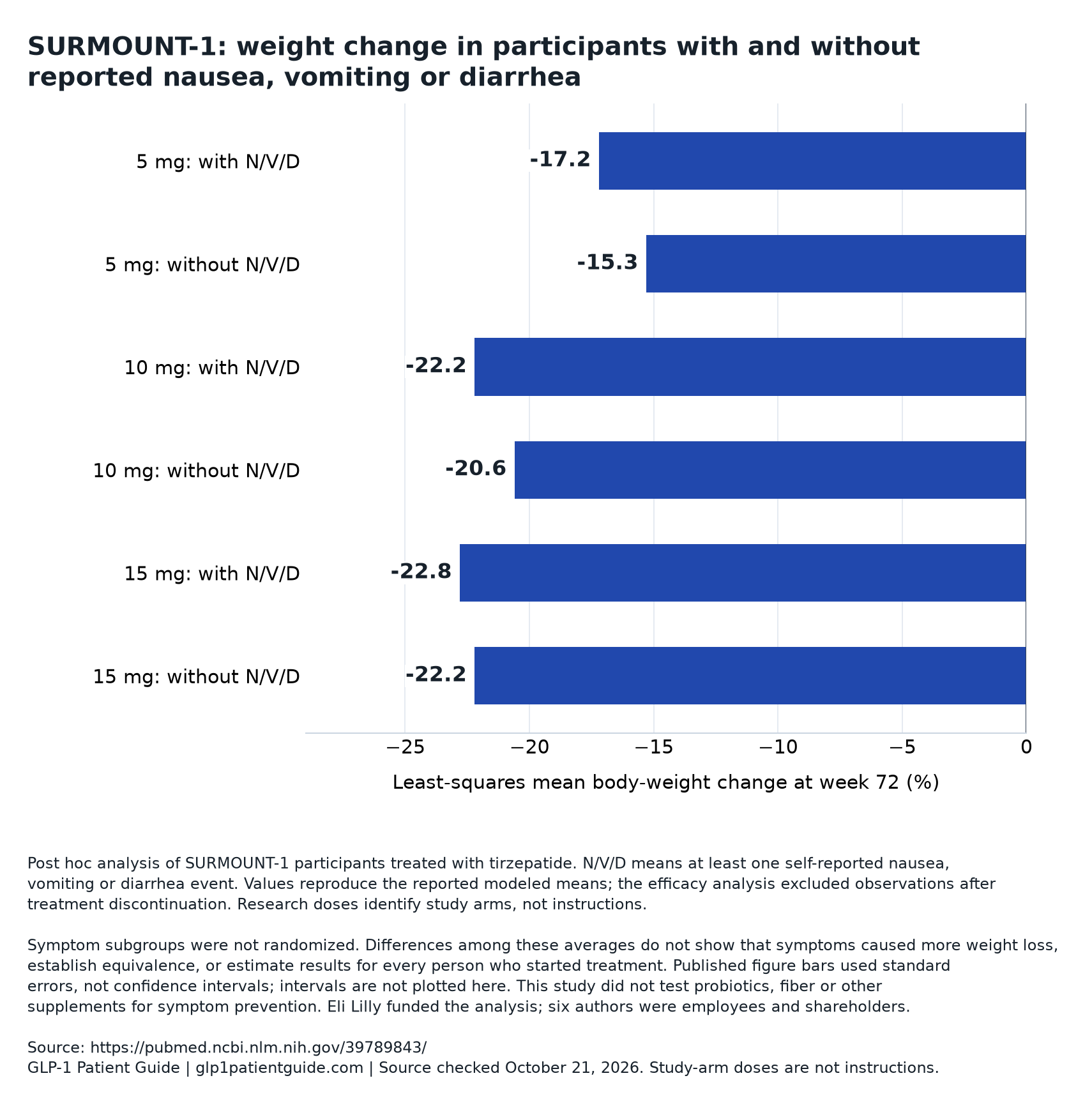
SURMOUNT-1: weight change in participants with and without reported nausea, vomiting or diarrhea
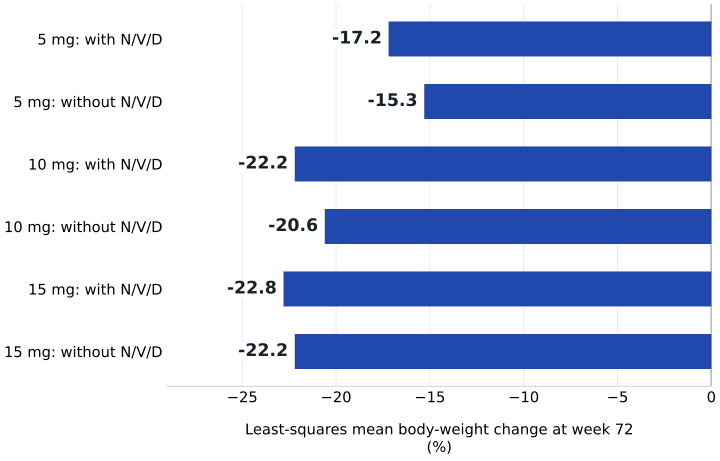
Post hoc analysis of SURMOUNT-1 participants treated with tirzepatide. N/V/D means at least one self-reported nausea, vomiting or diarrhea event. Values reproduce the reported modeled means; the efficacy analysis excluded observations after treatment discontinuation. Research doses identify study arms, not instructions.
Symptom subgroups were not randomized. Differences among these averages do not show that symptoms caused more weight loss, establish equivalence, or estimate results for every person who started treatment. Published figure bars used standard errors, not confidence intervals; intervals are not plotted here. This study did not test probiotics, fiber or other supplements for symptom prevention. Eli Lilly funded the analysis; six authors were employees and shareholders.
Source 1Download the source-labeled chart (PNG) · Download the data (CSV)
| Randomized dose and nonrandomized symptom subgroup | Reported value |
|---|---|
| 5 mg: with N/V/D | -17.2 |
| 5 mg: without N/V/D | -15.3 |
| 10 mg: with N/V/D | -22.2 |
| 10 mg: without N/V/D | -20.6 |
| 15 mg: with N/V/D | -22.8 |
| 15 mg: without N/V/D | -22.2 |
Sections in this article
Four trials asked related but different questions
The trials studied once-weekly tirzepatide injected under the skin against placebo. SURMOUNT-1 enrolled adults with obesity, or overweight with a weight-related condition, without type 2 diabetes. Its randomized arms were 5, 10 or 15 mg and placebo for 72 weeks. SURMOUNT-2 enrolled adults with overweight or obesity and type 2 diabetes, comparing 10 and 15 mg with placebo over 72 weeks. These doses identify research arms, not a personal dosing plan.
SURMOUNT-3 randomized participants after a 12-week intensive lifestyle program. SURMOUNT-4 used a withdrawal design: everyone initially received tirzepatide during a 36-week open-label lead-in, followed by 52 randomized weeks of continued treatment or placebo. Its total observation period was 88 weeks—not 88 randomized weeks after the lead-in. Both used a maximum tolerated dose of 10 or 15 mg.
The investigators mostly analyzed each trial separately, appropriately preserving these differences. All participants received lifestyle counseling. Known clinically significant gastric-emptying abnormalities and a history of pancreatitis were exclusion criteria, limiting what these results establish for people with those histories.
| Trial | Population or entry condition | Comparison and timeline |
|---|---|---|
| SURMOUNT-1 | Adults without type 2 diabetes | Tirzepatide 5, 10 or 15 mg versus placebo; 72 weeks |
| SURMOUNT-2 | Adults with type 2 diabetes | Tirzepatide 10 or 15 mg versus placebo; 72 weeks |
| SURMOUNT-3 | Adults without diabetes after intensive lifestyle intervention | Maximum tolerated tirzepatide versus placebo; 72 weeks after the lifestyle lead-in |
| SURMOUNT-4 | Adults without diabetes after open-label tirzepatide | 36-week lead-in plus 52-week randomized withdrawal period; 88 weeks total |
One reported event determined the symptom group
Participants self-reported adverse events, meaning unwanted medical experiences during the study. At visits, staff used open-ended, non-leading questions and recorded onset, end date and severity. A single qualifying event was enough to place someone in the symptom group. That classification therefore combined people with one brief episode and people with more disruptive or recurring symptoms.
For the principal weight analysis, the qualifying events were nausea, vomiting or diarrhea, abbreviated N/V/D. A sensitivity analysis broadened the definition to include dyspepsia, or indigestion. Constipation and other digestive complaints were not part of the primary N/V/D definition. Consequently, a participant classified as having no N/V/D was not necessarily free of every gastrointestinal problem.
Severity was recorded, but systematic gastrointestinal symptom scales were not used across the trials. Personal reporting thresholds and regional differences could affect classification. Interpretation: for a clinical assessment, the timing, recurrence and effect on eating or drinking may be more informative than an ever-versus-never label. The guide to intake and prescribing assessments provides context for organizing that history.
Source 1The clearest numbers come from dose-specific comparisons
In SURMOUNT-1, every tirzepatide arm showed substantial estimated average weight reduction in participants without reported N/V/D. Those reporting symptoms had somewhat greater average reductions, but the differences were small relative to the overall changes. The within-dose gaps were 1.9, 1.6 and 0.6 percentage points for the 5-, 10- and 15-mg arms, respectively.
These figures are model-adjusted group means, not predictions for an individual. A change of −20.6% means an average reduction corresponding to 20.6% of starting weight; the difference between −22.2% and −20.6% is 1.6 percentage points. It does not mean symptoms caused an extra 1.6% reduction.
The figure displayed standard errors, which describe the precision of estimated means, rather than confidence intervals. Numerical confidence intervals for these subgroup estimates are not reported in the main-text results used here. The analysis also did not establish formal equivalence between symptom groups: similar-looking averages are not proof that their outcomes are identical.
| Tirzepatide study arm | With N/V/D | Without N/V/D |
|---|---|---|
| 5 mg weekly injection | −17.2% | −15.3% |
| 10 mg weekly injection | −22.2% | −20.6% |
| 15 mg weekly injection | −22.8% | −22.2% |
The pattern extended to diabetes and lead-in trials
SURMOUNT-2 provided an important check in a different population. Among participants with type 2 diabetes, estimated mean weight changes with versus without N/V/D were −14.2% versus −13.1% in the 10-mg arm and −16.8% versus −15.0% in the 15-mg arm. Again, substantial average reduction occurred without those symptoms.
In SURMOUNT-3, the corresponding changes were −22.0% with N/V/D and −19.9% without it. In SURMOUNT-4, changes from the initial week-0 baseline were −26.3% and −25.7%. The latter figures include the open-label treatment period, so they should not be read as weight lost solely during randomized maintenance.
Consistency across these settings strengthens the observation that reported N/V/D was not required for substantial average weight reduction. It does not rank the trials or explain why their weight changes differed. Diabetes status, prior lifestyle intervention, treatment exposure and follow-up length all varied. Comparisons across studies cannot isolate any one of those influences.
Source 1Why the analysis favors an on-treatment experience
The efficacy analysis began with randomly assigned participants who received at least one study dose. It excluded data after treatment discontinuation in all four trials and after initiation of antihyperglycemic rescue therapy in SURMOUNT-2. Weight change was analyzed using a repeated-measures model, but the report also identifies availability of endpoint weight data as a limitation.
This matters because people who tolerate treatment and continue contributing measurements may differ from those who stop. If severe symptoms lead someone to discontinue, their later weight experience is not represented in the same way. The estimates therefore should not be presented as the average outcome for everyone who starts treatment regardless of subsequent events.
Nor were the N/V/D groups randomized. Baseline characteristics were generally similar, but some differences remained; for example, women represented a larger share of symptom-reporting groups. Treatment exposure, symptom management and other events after randomization could also influence both symptoms and weight. The analysis describes a relationship rather than a clean experiment on the consequences of nausea.
Source 1What the 3.1% mediation estimate actually means
Mediation analysis attempts to separate a treatment effect into a component statistically associated with an intermediate event and a component not associated with it. Here, that intermediate event was reported N/V/D, with dyspepsia added in the broader analysis. These models were conducted in SURMOUNT-1, -2 and -3—not SURMOUNT-4, whose lead-in and withdrawal design complicated this question.
The estimated proportions ranged from −0.7% to 2.5% in SURMOUNT-1, 0.8% to 2.0% in SURMOUNT-2 and 1.5% to 3.1% in SURMOUNT-3. These percentages describe the modeled share of the total estimated effect. For illustration only, 3.1% of a hypothetical 20-percentage-point treatment effect would be 0.62 percentage points, not 3.1 percentage points.
The small negative estimate should not be interpreted as evidence that symptoms protect against weight loss. These exploratory analyses were not adjusted for multiple comparisons or potential post-randomization confounders, and symptom timing was imperfectly represented. They support a small modeled contribution, not proof of a biological mechanism. Gastric emptying itself was not investigated in this analysis.
Source 1Frequent events and treatment discontinuation are different measures
Across the trial arms, any gastrointestinal adverse event was reported by 27.8%–72.8% of tirzepatide participants and 12.2%–32.5% of placebo participants. These broad ranges reflect different populations, doses and designs. Subtracting the lowest placebo value from the highest tirzepatide value would not produce a valid treatment comparison.
Most events were mild to moderate and occurred during dose escalation. Nevertheless, severe or serious gastrointestinal events affected 0.3%–5.6% of participants across the reported trial settings. Severe describes intensity; serious is a regulatory category involving outcomes such as hospitalization. Neither should be erased by describing the overall pattern as generally tolerable.
Gastrointestinal events led 1.0%–10.5% of tirzepatide-treated participants to stop treatment, compared with 0%–2.2% who discontinued study participation for those events. People could stop the medication while remaining under research follow-up. Interpretation: similarly, a service’s cancellation terms and its arrangements for clinical follow-up are separate documentary questions. The Ro review can be used to check documented terms, not to infer trial-level tolerability or outcomes.
Source 1Timing and symptom medication do not establish treatment efficacy
The trials included a 20-week dose-escalation period, and gastrointestinal events were concentrated during escalation. First use of antiemetic medication, which treats nausea or vomiting, and antidiarrheal medication occurred most often within the first 24 weeks. This does not mean later symptoms were absent or automatically unrelated to treatment.
In SURMOUNT-1 through -3, use of one antidiarrheal medication was reported by 5.2%–9.3% of tirzepatide participants versus 1.2%–2.2% with placebo. One antiemetic medication was reported by 13.8%–27.5% versus 5.8%–6.7%. These are observations of use, not randomized tests showing that a particular rescue medication prevented discontinuation.
The main report does not provide comparable median episode durations for tirzepatide that would justify a specific expected recovery timetable. Dietary counseling and symptom medications were available, but their effectiveness was not isolated experimentally; probiotics were not tested. Interpretation: ask how persistent symptoms are assessed rather than assuming access to messaging guarantees adequate follow-up. The care-format guide and Noom Med review can help frame questions about format and documented service terms.
Source 1Semaglutide offers context, not a tolerability ranking
A separate post hoc analysis pooled STEP-1 through -3 data for weekly injected semaglutide 2.4 mg and placebo over 68 weeks. It also found substantial weight reduction in participants without gastrointestinal events. Its mediation analysis attributed less than one percentage point of the additional weight reduction versus placebo to gastrointestinal events—a different unit from tirzepatide’s percentage of the total estimated effect.
That report supplies useful duration information: median individual semaglutide events lasted eight days for nausea, three for diarrhea and two for vomiting. Constipation lasted substantially longer, with a median of 47 days versus 35 with placebo. These are episode medians, not deadlines for recovery or reasons to delay assessment, and they cannot be substituted for tirzepatide-specific durations.
The separate STEP analysis explains those distinctions in detail. SURMOUNT-1 through -4 had no active medication comparator, so these reports cannot establish which drug causes fewer symptoms in otherwise comparable patients. The injection results also do not automatically transfer to oral formulations, compounded products or a particular provider’s care.
Source 1 Source 2Significant symptoms deserve assessment, not endurance
Current Zepbound labeling reports severe gastrointestinal reactions in a separate pool of two weight-reduction trials: 1.7%, 2.5% and 3.1% in the 5-, 10- and 15-mg arms versus 1% with placebo. This is not the four-trial range above and is not a head-to-head comparison with semaglutide. Zepbound is not recommended for people with severe gastroparesis.
Both Zepbound and Wegovy labeling warn about pancreatitis, gallbladder disease and kidney injury related to dehydration. Persistent or severe abdominal pain, sometimes radiating to the back, warrants prompt clinical assessment whether or not vomiting occurs. Significant ongoing vomiting, diarrhea or difficulty maintaining hydration also merits clinical attention; trial averages are not a self-treatment timetable.
Both labels describe delayed gastric emptying and rare postmarketing aspiration reports during anesthesia or deep sedation. Patients should tell procedural teams about treatment; the labels do not establish a universal withholding schedule. Postmarketing bowel-obstruction reports likewise do not establish an incidence rate. Interpretation: the guide to a care plan that no longer fits can help organize follow-up questions, but significant symptoms require clinical assessment rather than a contract discussion alone.
Source 3 Source 4Questions about the evidence
If I do not feel nauseated, does that mean tirzepatide is not working?
No. In the analyzed trial groups, substantial average weight reduction occurred without reported nausea, vomiting or diarrhea. Symptoms were not a reliable marker of benefit. That finding does not predict any individual’s response; response needs assessment through clinical follow-up rather than the presence or absence of discomfort.
Source 1Did people with symptoms lose more weight?
Their estimated average reductions were often somewhat larger. However, participants were not randomized to symptom groups, and measurements after treatment discontinuation were excluded. The differences therefore do not show that nausea caused additional weight loss or that provoking symptoms would improve outcomes.
Source 1How long should digestive symptoms last?
The tirzepatide report locates most events around dose escalation but does not provide a dependable individual recovery timetable. Semaglutide episode medians from a separate study are not tirzepatide forecasts. Severe, persistent or worsening symptoms should be assessed on their clinical significance, not tolerated until a study median has passed.
Source 1 Source 2 Source 3Do these findings prove that anti-nausea medicines or probiotics help?
No. Investigators recorded symptom-medication use, but did not randomly assign those treatments to test effectiveness. The report therefore cannot establish how much they improved tolerability or continued treatment. It also provides no randomized evidence that probiotics prevent these symptoms or improve weight outcomes.
Source 1Who funded the analysis, and how much evidence was examined?
Eli Lilly funded the tirzepatide analysis; six authors were Lilly employees and shareholders, and company writing support was acknowledged. This explanation uses the full primary report, including its methods, results and main table, plus relevant official labeling. Supplementary tables and original trial protocols were not independently examined. Industry involvement warrants transparency, not automatic dismissal of the findings.
Source 1 Source 3 Source 4Editorial assessment
The most defensible interpretation is that reported nausea, vomiting and diarrhea accounted for little of tirzepatide’s estimated weight-reduction effect in these exploratory analyses. Substantial reductions without those symptoms appeared across several study designs, including a population with type 2 diabetes. That consistency is informative, but on-treatment selection, self-reporting and unmeasured post-randomization differences prevent a definitive causal conclusion. For patients, the practical distinction is clear: discomfort is not a necessary sign of benefit, and meaningful symptoms deserve assessment rather than being treated as proof that medication is working.
Research access and limitations
This is an explanation of post hoc trial evidence and selected current safety labeling, not a complete prescribing review. Symptom groups were not randomized, confidence intervals for the quoted subgroup means were not available in the main-text results, and supplementary materials were not independently reviewed.
Where the information comes from
Scientific sources checked October 21, 2026. Earlier research and provider sources retain their dated histories below. Provider pages describe their own offers; they do not independently prove the quality of care.
- Gastrointestinal tolerability and weight reduction associated with tirzepatide in adults with obesity or overweight with and without type 2 diabetes in the SURMOUNT-1 to -4 trials.Full primary post hoc report, Methods, Results, main Table 1 and Discussion/funding reviewed; supplementary tables and source-trial protocols not separately reviewed. · Checked 2026-10-21
- Gastrointestinal tolerability of once-weekly semaglutide 2.4 mg in adults with overweight or obesity, and the relationship between gastrointestinal adverse events and weight loss.Full primary post hoc analysis main text and main Table 1 reviewed; supplementary file and original trial protocols not independently reviewed. · Checked 2026-10-21
- DailyMed: ZEPBOUND tirzepatide current prescribing informationCurrent official DailyMed label, updated August 28, 2026, current archive September 2, 2026; indications, relevant safety sections 5.2 through 5.5 and 5.9, postmarketing experience and oral-drug interaction sections reviewed. Other sections not fully reviewed. · Checked 2026-10-21
- DailyMed: WEGOVY semaglutide current prescribing informationCurrent official DailyMed label, updated June 18, 2026, current archive June 30, 2026; indications, relevant safety sections 5.2, 5.3, 5.5, 5.6, 5.10, postmarketing experience and oral-drug interaction sections reviewed. Other sections not fully reviewed. · Checked 2026-10-21